
From the blog
Extract Ratios and “Dry Powder Equivalents”, Explained
An extract ratio such as 10:1 says ten parts of dried plant were concentrated into one part of extract. It describes how much raw material went in, not how much of the active compound came out. A footnote reading “equivalent to approximately 567 mg of dry powders” is the same kind of claim, and even taken at face value it puts every ingredient in the Horse Boost blend at roughly 63 mg — still below every studied dose on the label.
What an extract is, before the ratio
Start with the thing itself. A herbal extract is what you get when you take dried plant material, soak it in a solvent — water, alcohol, or a mixture — and then remove the solvent, leaving behind a concentrated powder or liquid.
The point of doing this is that most of a dried plant is not the part anyone is interested in. It is cellulose, starch, fibre and water. The compounds that made the plant worth studying might be one or two per cent of its dry weight. Extraction concentrates those compounds and throws away the rest, which is why 100 mg of a good extract can be more useful than a gram of the raw powder.
That is the honest case for extracts, and it is a strong one. A well-made extract is a better product than a ground-up leaf. The trouble starts with how the concentration is described.
What a ratio does and does not say
An extract ratio is written as two numbers: 10:1, 4:1, 20:1. It means that the stated weight of dried plant material was used to produce one part of finished extract. A 10:1 extract took ten kilograms of herb to make one kilogram of powder.
Read that sentence again, because the important part is what it leaves out. The ratio describes the input. It says nothing about the output — how much of the compound anyone cares about actually ended up in the extract.
| What the ratio tells you | What it does not |
|---|---|
| How much raw plant was used | How much active compound is present |
| Roughly how concentrated the process was | Which solvent was used, and what it pulled out |
| A rough idea of cost and yield | Whether the batch matches the one used in a trial |
| That some concentration happened | How much, of the thing that matters |
The gap is not academic. Two manufacturers can both produce a “10:1 green tea extract” and end up with powders differing several-fold in catechin content, depending on the solvent, the temperature, the part of the plant used, the growing conditions and how the extract was dried. Both labels are accurate. Neither tells you what you need.
This is why serious supplement labels print a different number entirely.
Standardisation, which is the number that matters
A standardised extract is one guaranteed to contain a stated percentage of a named compound. “Ashwagandha root extract, standardised to 5% withanolides.” “Green tea extract, standardised to 50% EGCG.” “Epimedium extract, standardised to 20% icariin.”
That single phrase does what a ratio cannot. It tells you what is in the powder rather than what went into making it, and it lets you compare a product directly with the research, because trials report their doses the same way.
Find the milligram amount
How much extract is in a serving.
Find the standardisation
What percentage of the active compound the extract carries.
Multiply
600 mg at 5% withanolides is 30 mg of withanolides.
Compare with the trial
Trials report the same two numbers. Now the comparison is like for like.
When a label prints a ratio instead of a standardisation, it is usually because a standardisation would be less flattering, or because the manufacturer buying the ingredient did not specify one. Neither is illegal. Both are worth noticing.
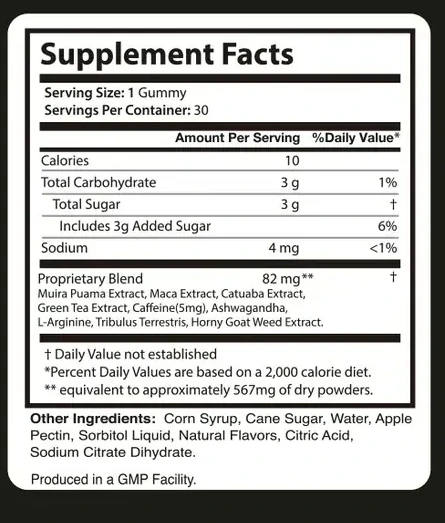
The Horse Boost panel prints no standardisation for anything, and no Latin names either, which compounds the problem for two of its ingredients: “catuaba” covers at least two unrelated plants, and “horny goat weed” covers several Epimedium species with different icariin content.
The 567 milligram footnote
Under the blend line, in the smallest type on the panel, Horse Boost prints this: “** equivalent to approximately 567 mg of dry powders”.
It is a dry-powder-equivalent claim. It says the 82 mg of extract in the blend stands in for roughly 567 mg of raw dried herb — an average ratio of about seven to one across the nine ingredients.
Before criticising it, give it credit. Most labels with a proprietary blend print no such footnote at all, and a buyer is left with a bare number and no context. This one at least attempts to say what the number represents. It is an argument, and arguments can be examined.
The footnote claims the 82 mg of extract stands in for about 567 mg of raw powder — a ratio of roughly seven to one. Take the claim at face value and split 567 mg nine ways and you get about 63 mg each, which is still below every trial dose on this page. It is the most generous reading of the label, and it does not change the answer.
So examine it. Take the claim entirely at face value, ignore everything said above about ratios not equalling potency, and treat the blend as though it really were 567 mg of dried herb.
Split 567 mg nine ways and you get about 63 mg each. Ashwagandha is studied at 300 to 600 mg. Green tea extract at 250 to 500 mg. Maca at 1,500 to 3,000 mg. L-arginine at 3,000 to 6,000 mg.
The most generous possible reading of this label — the one the footnote itself invites — still lands below every benchmark, for every ingredient, by a wide margin. That is worth stating plainly, because it means the argument about extract ratios does not actually need to be won. It can be conceded, and the answer does not change.
There is one more thing the footnote quietly reveals. A seven-to-one average implies the ingredients are not all 10:1; some must be weaker concentrates, or whole powders at 1:1. Which ones, the label does not say. A buyer hoping the ashwagandha is the concentrated part and the filler-ish names are the dilute part has no way to check that hope, and the ordering rule points the other way: ashwagandha sits sixth of nine.
None of which makes the footnote dishonest. It makes it incomplete in the specific way this whole label is incomplete — it offers a number in place of the number that would settle the question.
Three things a ratio ignores
Beyond the input-versus-output problem, an extract ratio is silent on three variables that change what is in the jar. All three are printable in a line of text, and none of them appears on this panel.
| Variable | Why it changes the product | On this label |
|---|---|---|
| Species | Common names cover several plants. “Catuaba” is used for at least two unrelated species with different chemistry, and “horny goat weed” for several Epimedium species with icariin content varying several-fold. | Not stated for any ingredient |
| Plant part | Root, leaf, seed and bark differ chemically within one species. Ashwagandha trials overwhelmingly use root extract; leaf extract is a different material. | Not stated |
| Solvent | Water pulls out different compounds from alcohol. Two 10:1 extracts made with different solvents are not interchangeable. | Not stated |
The species point is the one with practical consequences here. Two of the nine ingredients on this panel are named only by a common name that covers more than one plant. A Latin name costs nothing to print and would settle it. Its absence means that even a buyer willing to research the ingredient cannot be sure which research applies.
This is also why the phrase “natural herbal extract” carries so little information. Natural describes where the material came from. It says nothing about which plant, which part, which process, or how much.
Read the Horse Boost panel for yourself, footnote and all.
Check today’s priceWhere ratios genuinely help
It would be a poor article that left you thinking extract ratios are always a dodge. They are not, and knowing when they are useful is part of reading a label well.
Comparing two versions of one herb
A 10:1 and a 4:1 extract from the same supplier, of the same plant, genuinely differ in concentration. The ratio is the right comparison.
Traditional-use products
Some herbs have centuries of use as a whole-plant preparation and no identified single active compound. A ratio is the only honest description available.
Cost and plausibility checks
A 100:1 extract of a cheap herb is a claim worth questioning. Ratios let you sanity-check what a manufacturer says it did.
Alongside a standardisation
The best labels print both: the ratio and the percentage. That is a complete description.
The rule is simple enough. A ratio is useful as a supplement to a standardisation, and misleading as a substitute for one. When it appears alone on a product sold for a specific effect, it is doing a job that a percentage should be doing.
How to check any extract claim in two minutes
This works on any bottle, and it needs nothing but the label and a search box.
| Step | What to look for | What it tells you |
|---|---|---|
| 1 | The milligram amount | The only number that anchors everything else |
| 2 | A standardisation percentage | Whether the label is describing the output or the input |
| 3 | A Latin name | Whether you know which plant you are buying |
| 4 | The plant part | Root, leaf, seed and bark differ chemically in the same species |
| 5 | The trial dose | Search the ingredient plus “dose”; abstracts give it in the first lines |
| 6 | The comparison | Label amount versus trial amount, same units, no adjectives |
The bottom line
An extract ratio describes what went into a process. A standardisation describes what came out of it. Only the second one connects a product to the research that made its ingredients interesting.
The Horse Boost panel gives a blend total of 82 mg, no standardisation for anything, no Latin names, and a footnote saying the extract represents about 567 mg of dry powder.
Take the footnote seriously and the arithmetic still does not work: 567 mg divided by nine is about 63 mg each, against studied doses running from 300 mg to 6,000 mg. The footnote is the best argument this label has, and it is not enough.
Sources
- U.S. Food and Drug Administration. Dietary Supplement Labeling Guide, Chapter IV: Nutrition Labeling. FDA guidance for industry. Checked September 24, 2026.
- National Center for Complementary and Integrative Health. Ashwagandha. NCCIH, current page. Checked September 24, 2026.
- National Center for Complementary and Integrative Health. Green Tea. NCCIH, current page. Checked September 24, 2026.
- National Center for Complementary and Integrative Health. Maca. NCCIH, current page. Checked September 24, 2026.
- Memorial Sloan Kettering Cancer Center. Epimedium / Horny Goat Weed (About Herbs). MSK integrative medicine database. Checked September 24, 2026.
- U.S. Food and Drug Administration. Dietary Supplements: What You Need to Know. FDA, current revision. Checked September 24, 2026.
Questions on this topic
More answers on the full FAQ page.
What does 10:1 extract mean?
Ten parts of dried plant material were used to make one part of extract. It describes the input, not how much active compound is in the finished powder.
Is a higher ratio better?
Not necessarily. A higher ratio means more raw material was used, but without a standardisation percentage it says nothing about the compound you care about.
What is standardisation?
A guarantee that an extract contains a stated percentage of a named compound, such as 5% withanolides. It is the number that lets you compare a product with a trial.
What does “equivalent to 567 mg of dry powders” mean?
That the 82 mg of extract is said to represent about 567 mg of raw dried herb — a ratio of roughly seven to one. Split nine ways that is about 63 mg each, still below every studied dose on the label.
Does the footnote change the conclusion?
No. Even accepted in full, it puts each ingredient far below the amount used in research.
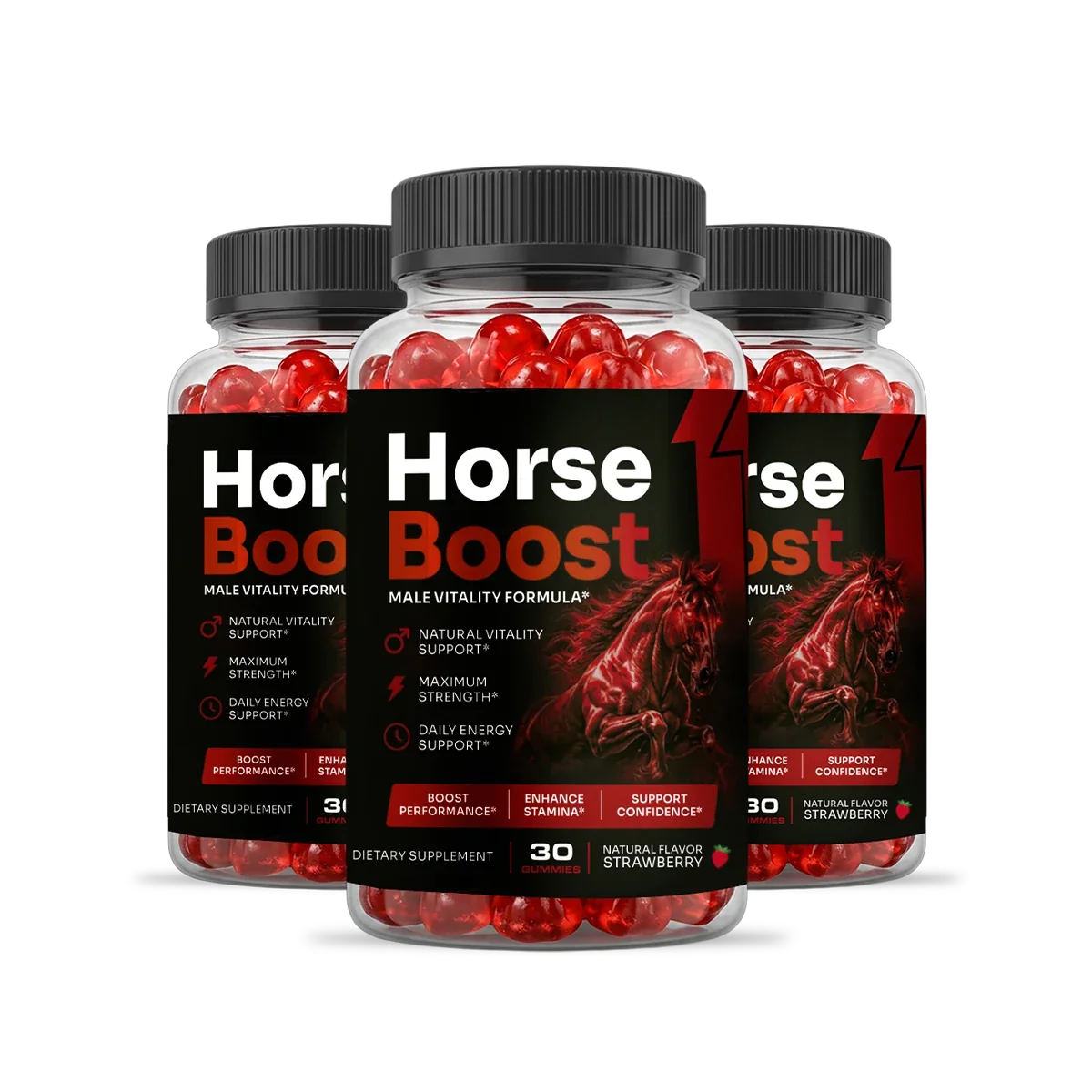
Ready to try Horse Boost?
Pick a pack and see the price at checkout. The money-back guarantee is 60 days from purchase, unless the sales page prints a longer window. Questions first? Contact the order desk.
Sold through a USA Authorized Horse Boost Retailer. This site is not the manufacturer and earns when you buy.Keep reading
How to read a proprietary blend
What a proprietary blend hides, the two things it still tells you, how to work out an ingr…
Read more →Gummies vs capsules
Why gummies hold less active ingredient than capsules, what the sugar adds up to, why they…
Read more →Horse Boost ingredients
All nine names inside the blend, one by one.
Read more →